IN SHORT
Mental Health and Orthodontics: By improving your self-image, you can enhance your overall well-being. Studies have shown that malocclusions can be associated with lower self-esteem, anxiety, and even a higher risk of depression. By improving satisfaction with appearance and overall health, orthodontic treatment can help boost self-esteem and quality of life.
A growing number of studies and personal accounts confirm it: there is a link between mental health and orthodontics, and this approach can improve your well-being. With Mental Health Week upon us, now is the perfect time to talk about it. For many people, dental malocclusions can lead not only to physical discomfort but also to anxiety and isolation. What if we told you that one of the keys to your well-being might be found at the orthodontist’s office?
When a Smile Becomes a Complex
Even before we say a word, our smile speaks for us. It conveys our ease, our joy, and our desire for social connection. But when we’re self-conscious about our teeth, we often instinctively hold back. We laugh less spontaneously. We smile without showing our teeth, and we avoid having our picture taken. We try to hide our mouths when we speak.
It’s not just a matter of vanity: it’s a very real discomfort that can affect self-confidence and how we feel in social situations. This can be just as true for teenagers as it is for adults.
Dentition and Mental Health: A Clear Link
The scientific literature is clear: dental problems have a direct impact on mental health. In fact, severe malocclusion is associated with increased levels of anxiety and depression[1]; the more severe the malocclusion, the greater the impact.
The effects of malocclusion go beyond appearance. It can also affect oral health, digestion, breathing, and even speech. These are issues that, in turn, can weigh on overall well-being. This vicious cycle is well-documented: when the body suffers, psychological well-being is affected, and vice versa.
Beyond the social discomfort caused by malocclusion, it can indirectly affect your dental health, your physical health, and, by extension, your overall well-being.
What Orthodontics Actually Changes
The benefits of orthodontic treatment for oral health are well documented, but studies are also beginning to draw links between mental health and orthodontics. In fact, a 2016 study of 102 adults who underwent orthodontic treatment demonstrates a significant effect. Between the start of treatment and six months after treatment, on average:
- Satisfaction with their smile rose from 14.7% to 97.1%
- Self-esteem increased from 56.9% to 96.1%
- Satisfaction with facial appearance rose from 38.2% to 77.5%[2]
Of course, teeth aren’t everything! But based on studies and numerous testimonials, the link between mental health and orthodontics is closer than you might think. One thing is certain: feeling confident about your teeth helps you smile and laugh without worrying about what others think.
Adults or Teens: An Investment in Your Well-Being
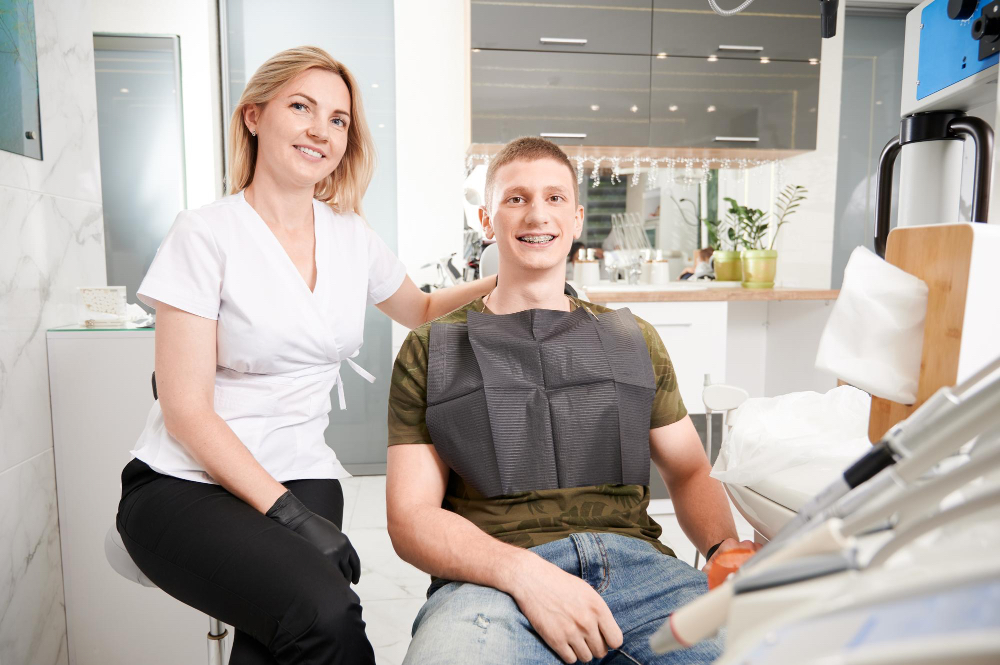
Adolescence is a critical period during which young people develop their sense of identity and self-esteem. At this age, when the opinions of others matter greatly, feeling uncomfortable smiling can amplify feelings of insecurity. This is one of the reasons why adolescence is the ideal time for treatment. But it’s never too late: more and more patients are seeking treatment as adults, and for good reasons! Today, we keep our teeth healthy well into adulthood more than ever before, making orthodontics a much longer-term investment.
Although straight teeth are often associated with an aesthetic ideal, it’s important to remember that the benefits go far beyond that. Orthodontic treatment can improve chewing function and oral hygiene, and help reduce certain speech or breathing difficulties. In addition, orthodontics can address a variety of health issues.
The appearance of orthodontic appliances themselves is often a source of hesitation. Keep in mind that today there are discreet options available: Invisalign treatments, as well as clear aligners.
Mental Health and Orthodontics: Taking Care of Yourself, One Appointment at a Time
Do you avoid laughing out loud or cover your mouth? Are you concerned that your child doesn’t like the way their teeth look? Do people tell you that you don’t smile much? If the appearance of your teeth is a source of self-consciousness, we can help.
We understand that some people are concerned about the appearance of braces. By discussing your needs with you, we can determine the most effective solution to balance your desire for discretion with your goal of improving your appearance.
Dr. Normand Bach, a renowned orthodontist in Montreal, can help you rediscover the joy of smiling, one appointment at a time.
___ ___ ___
[1] Alsulaiman OA, et al. (24 février 2025). Mental Health and Malocclusion: A Comprehensive Review. Clin Pract. 15(3):44. doi: 10.3390/clinpract15030044.
[2] de Couto Nascimento V et al. (Sept. 2016). Impact of orthodontic treatment on self-esteem and quality of life of adult patients requiring oral rehabilitation. Angle Orthod. 86(5):839-45. doi: 10.2319/072215-496.1.
